
AI Technologies
AI in Web Development: A Practical Guide to Coding, Powerful Tools, and Real-World Experience

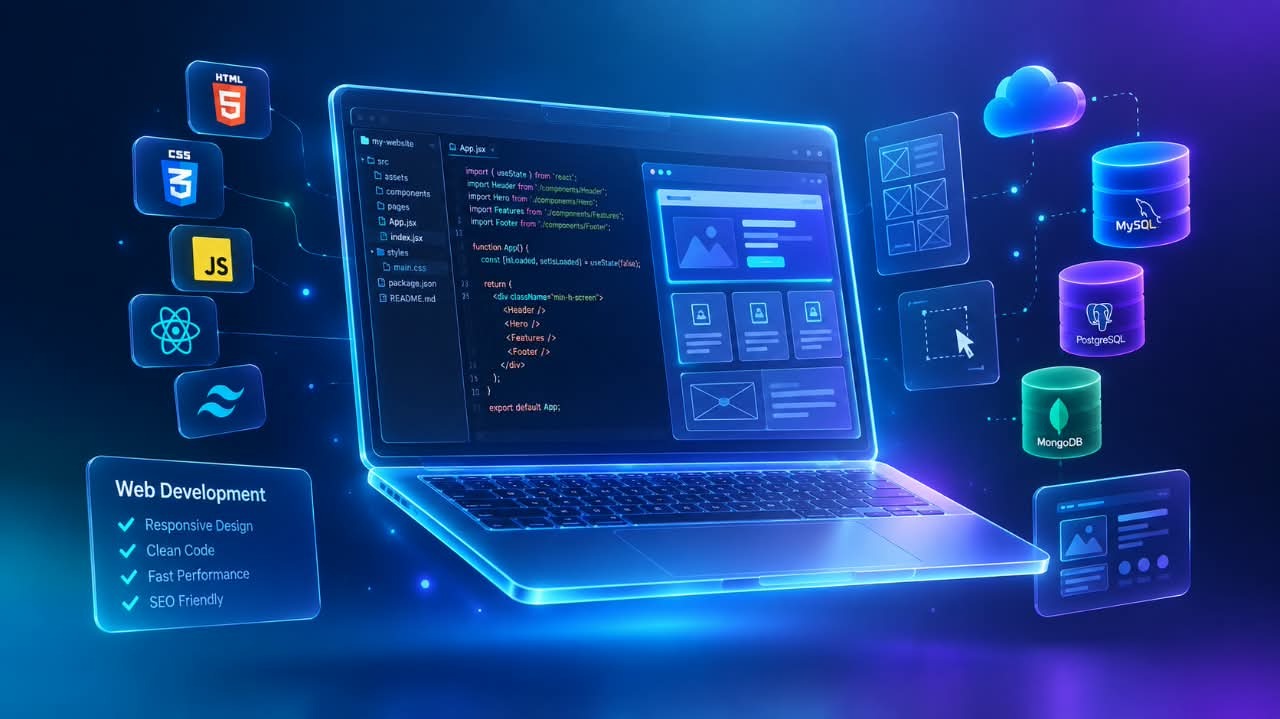
AI is changing how websites are built. It can now help with coding, debugging, design, testing, content, and other development tasks that once required more manual work. But AI-generated code is not always ready to use.
I learned this through my own experience while developing an e-commerce website. I worked with HTML, CSS, and JavaScript in VS Code and used AI tools such as GitHub Copilot, ChatGPT, and Claude. AI helped me create the whole project, including the homepage, product page, and other parts of the website. Sometimes the generated code worked correctly, but most of the time I had to modify it because of bugs or errors.
This experience shaped how I see AI in web development. It can save time and make development easier, but developers still need to test, understand, and improve the output.
What Is AI in Web Development?
AI in web development means using artificial intelligence to help build, improve, test, or manage websites and web applications.
AI tools can generate code from simple instructions, explain existing code, find possible errors, suggest designs, create content, and analyze user behavior. Machine learning can identify patterns in data, while natural language processing helps AI understand written instructions.
Generative AI has made this process even easier because developers can describe what they want instead of writing every line from the beginning.
For example, a developer can ask an AI tool to create a responsive product card using HTML, CSS, and JavaScript. The tool can quickly produce a starting version. The developer can then test it and make changes.
AI does not remove the development process. It changes how developers complete parts of that process.
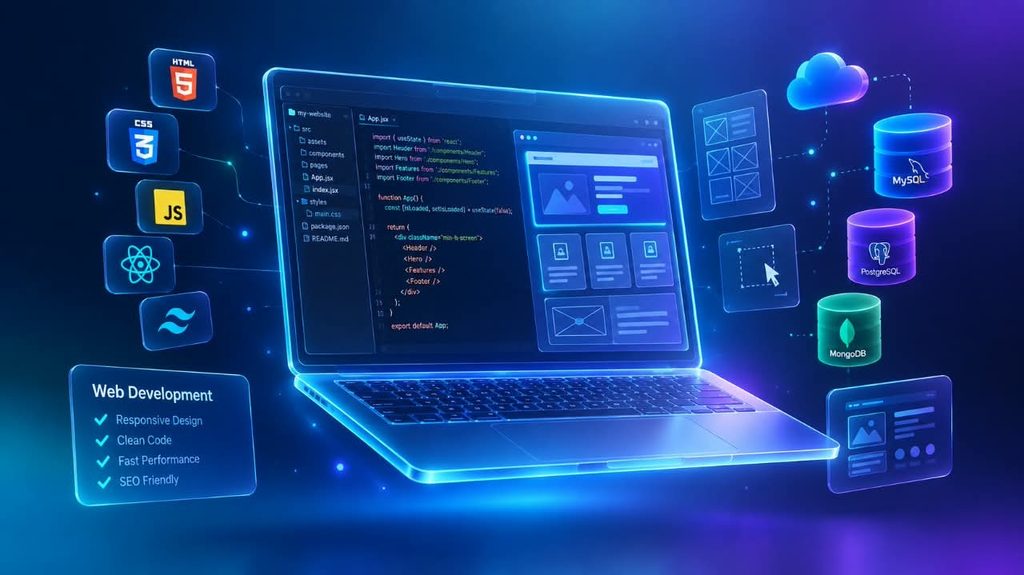
How AI Is Used in Web Development
AI can support many stages of web development. Its value is especially clear when developers need to handle repetitive tasks or quickly create a first version of a feature.
AI-Assisted Coding
AI coding assistants can generate code, complete functions, explain code, and suggest fixes for errors.
Tools such as GitHub Copilot, ChatGPT, and Claude can help developers work with HTML, CSS, JavaScript, and other programming languages. They can also help turn a written description into a basic working feature.
I used these tools while developing my ecommerce website. AI helped me create different parts of the project instead of making me write everything from scratch.
However, the generated code was not always reliable. I often had to modify it because it contained bugs or did not work exactly as expected. This taught me that AI-generated code should be treated as a starting point that needs testing.
AI-Powered Web Design
AI can also help create website layouts and user interface ideas. AI website builders and design tools can suggest page structures, visual elements, typography, and responsive layouts.
Tools such as Wix AI, Framer AI, Uizard, and Canva AI can help users create an initial design more quickly.
This can be useful for beginners who do not have advanced design skills. Developers can then adjust the result to match the website’s purpose, branding, accessibility needs, and target users.
AI can speed up the design process, but human decisions are still needed to make sure the final interface is practical and easy to use.
AI Testing and Debugging
AI can help developers find and fix errors in code. It can explain error messages, suggest possible causes, and generate corrected versions of code.
I used Claude-based AI tools for debugging during my development work. When generated code caused problems, AI helped me understand possible errors and suggest changes.
This was useful, but I still needed to test the result myself. A suggested fix can solve one problem while creating another, so developers should always run the website after making changes.
Website Personalization
AI can analyze user behavior and help websites provide more relevant experiences.
For example, an ecommerce website can recommend products based on previous browsing or purchasing activity. A content website can suggest articles based on the topics a visitor has already viewed.
Personalization can improve the user experience when it is based on useful and appropriate data. At the same time, websites need to handle user information carefully and respect privacy.
AI Chatbots and Virtual Assistants
AI chatbots allow websites to answer questions and provide support automatically.
A chatbot can help users find information, understand products, answer common questions, or locate support resources. This can reduce the need for human staff to answer every simple question.
However, complex problems may still require human support. AI works best when users can move to a human representative when automated answers are not enough.
Performance and Security Optimization
AI can help identify website performance problems, unusual activity, and possible security issues.
For example, AI systems can analyze website behavior and identify slow pages or unusual traffic patterns. Some tools can also help developers find possible weaknesses in code.
AI should support security work rather than replace it. Developers still need to review authentication, permissions, input validation, APIs, and other important parts of a website.

Benefits of Using AI in Web Development
The main benefit of AI is that it can reduce the time needed for many development tasks.
AI can generate a starting version of code within seconds, explain unfamiliar programming concepts, suggest solutions, and help developers debug problems.
It can also reduce repetitive work. Instead of manually creating similar pieces of code, a developer can ask an AI tool to generate them and then review the result.
AI can also make development more accessible to beginners. Someone learning JavaScript, for example, can ask an AI tool to explain an error in simple language.
My experience with the ecommerce project showed me that the time saved depends on the task. Some tasks were completed quickly with AI, while others required several modifications and debugging steps. AI is therefore not a fixed time-saving solution. Its value depends on the complexity of the work and how much correction the output needs.
Tools Used for AI in Web Development
Different AI tools are useful for different development tasks, so choosing one depends on the project.
AI Coding Assistants
GitHub Copilot can provide code suggestions while developers work in their coding environment. ChatGPT and Claude can help with code generation, explanations, debugging, documentation, and problem-solving.
I have used GitHub Copilot, ChatGPT, and Claude, and I found all of them useful in different ways. They are powerful tools, but they can still generate code with bugs and errors.
That means developers should choose tools based on the task rather than expecting one tool to handle everything.
AI Design and Website Builders
Tools such as Wix AI, Framer AI, Uizard, and Canva AI can help generate website layouts and design ideas.
They are useful when someone needs to create a prototype or quickly explore different design options. A production website still needs careful work on responsiveness, accessibility, performance, security, and branding.

AI Testing and Optimization Tools
AI testing tools can help automate parts of website testing and identify possible problems. Other AI systems can analyze user behavior and website performance.
When selecting an AI tool, consider its features, cost, compatibility with your development environment, reliability, and how much manual checking it requires.
A tool that produces fast results but creates many bugs may not actually save much time.
How to Use AI in a Web Development Project
AI works best when it is used as part of a structured development process.
Define the Project Requirements
Start by deciding what the website needs to do.
Give the AI clear information about the pages, features, technologies, design requirements, and target users. Instead of asking AI to build an entire complex website with one prompt, divide the project into smaller tasks.
For example, you can first work on the homepage, then the product page, then navigation and other features.
Clear instructions make it easier to understand and test the generated result.
Generate and Refine AI Output
After defining the requirements, ask AI to create the code or feature you need.
Do not assume that the first answer is the final answer. Run the code and check whether it works.
If something fails, give the AI the specific error and explain what you expected to happen. You can then review the suggested changes and modify the code yourself when necessary.
This is similar to how I worked on my ecommerce project. AI created much of the code, but I had to modify many parts before they worked properly.
Test and Validate the Website
Testing is essential when using AI-generated code.
Check buttons, forms, navigation, layouts, JavaScript functions, and other important features. Test the website on different screen sizes and browsers when possible.
Also check the code for security and accessibility problems.
AI can suggest that something is fixed, but only actual testing can show whether the website behaves correctly.
Deploy and Monitor the Website
After testing, the website can be deployed to a suitable hosting environment.
The work does not end after deployment. Developers should monitor errors, performance, security, and user behavior.
AI can help analyze some of this information, but developers still need to decide which changes are appropriate.
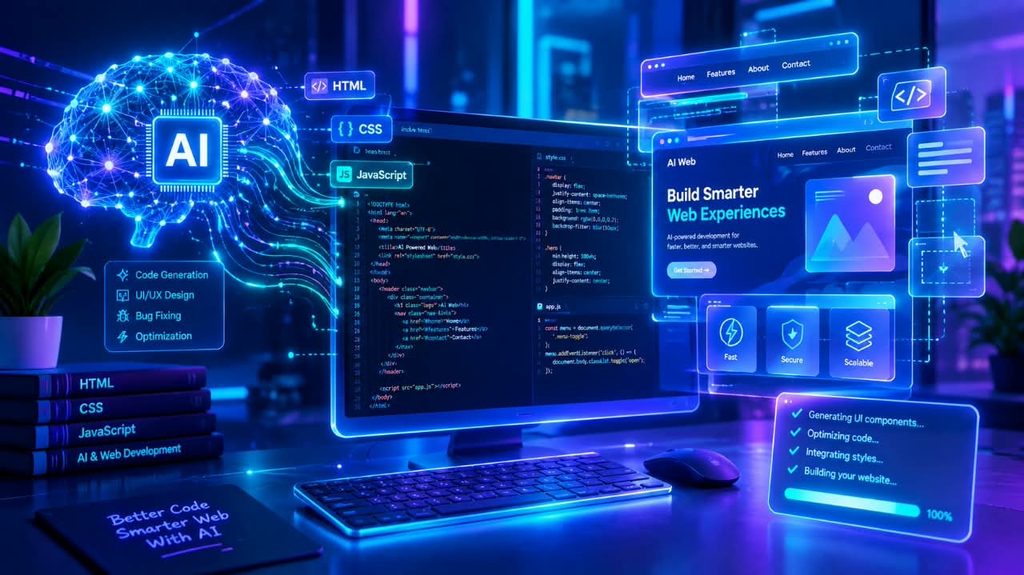
Challenges and Limitations of AI in Web Development
AI provides useful support, but it also has clear limitations.
Code Accuracy and Reliability
AI can generate code that looks correct but contains bugs or does not fit the rest of the project.
I experienced this repeatedly while developing my ecommerce website. Although AI helped create many parts of the project, I often had to modify the generated code.
This is why developers should never assume that AI-generated code is automatically production-ready.
Privacy and Security
Developers should be careful when sharing information with AI services.
Private customer information, passwords, API keys, confidential project data, and other sensitive information should not be shared carelessly.
AI-generated code also needs security review, especially when it handles authentication, payments, databases, or user information.
Over-Reliance on AI
AI can help developers work faster, but relying on it for every decision can reduce understanding of the code.
Developers should still learn the basics of programming and understand the code they use. If something breaks, they need enough knowledge to investigate the problem.
AI should support learning and development, not replace them.
Cost and Integration Complexity
Some AI tools require paid subscriptions. Larger projects can also require additional infrastructure and integration work.
A tool may appear inexpensive but still require significant time for testing and correction.
The real cost should include subscriptions, development time, debugging, maintenance, and human review.
AI in Web Development: A Practical Example
My ecommerce website is a practical example of how AI can be used during web development.
I worked with HTML, CSS, and JavaScript in VS Code and used AI tools to help write the code. AI helped create the whole project, including the homepage, product page, and other sections.
I used GitHub Copilot, ChatGPT, and Claude for different development tasks. Claude-based tools were particularly useful for debugging.
The process was not perfect. Sometimes AI-generated code worked correctly, but most of the time I needed to modify the output. Bugs and errors were common enough that testing became an important part of my workflow.
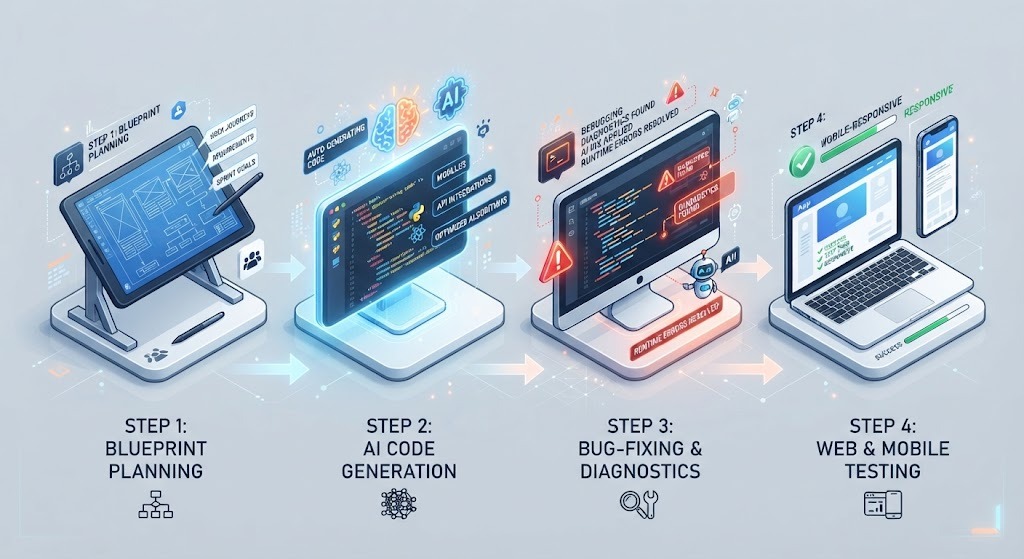
My basic process was:
Plan the feature → Ask AI for code → Run the code → Find problems → Use AI for debugging → Modify the code → Test again
This experience taught me that AI can make development faster, but it does not remove the need for programming knowledge or human review.
The Role of Developers in AI-Powered Web Development
AI can handle repetitive tasks, generate code, and provide suggestions, but developers remain responsible for the final product.
A developer needs to decide how different parts of the website should work together. They also need to consider security, accessibility, performance, user experience, and maintainability.
AI can produce technically valid code that still does not fit the project’s needs. Human judgment is needed to decide whether the solution is actually appropriate.
My own experience supports this. AI helped me create large parts of my ecommerce project, but I still had to review and modify the results.

Future of AI in Web Development
AI is likely to become more deeply connected to the full web development process.
Future tools may handle more coding, testing, design, debugging, personalization, and website monitoring. AI-powered websites may also become more adaptive by responding to user behavior.
Generative AI, voice interfaces, intelligent search, automated testing, and personalized experiences are already influencing web development.
The role of developers may change as these tools become more capable. Instead of spending as much time on repetitive coding, developers may spend more time planning systems, reviewing AI output, solving complex problems, and making final decisions.
Conclusion
AI in web development has become a useful tool for developers, but it is not a replacement for human developers.
My experience building an ecommerce website showed me both sides of AI. GitHub Copilot, ChatGPT, and Claude helped me create large parts of the project and save time, but the generated code often contained bugs or needed modifications.
The most practical approach is to use AI as a development assistant. Give it clear tasks, review the code, test every important feature, and fix problems before deployment.
AI can make web development faster and easier. The final quality still depends on how well the developer understands, checks, and improves what AI produces.
Frequently Asked Questions About AI in Web Development
Can AI completely replace web developers?
No. AI can generate code, help with debugging, create designs, and automate repetitive development tasks, but developers are still needed to plan projects, review code, solve complex problems, test websites, and make final decisions. My own experience showed me that AI-generated code often needed modification before it worked correctly.
Is AI-generated code always accurate?
No. AI-generated code can contain bugs, errors, outdated methods, or code that does not fit the rest of a project. While building my ecommerce website, I found that some AI-generated code worked correctly, but I often had to modify and debug other parts. Testing every important feature is essential.
Which AI tools can help with AI in web development?
Tools such as GitHub Copilot, ChatGPT, and Claude can help with coding, explanations, debugging, and development tasks. Other tools, including AI website builders and design platforms, can help create layouts and prototypes. The right tool depends on your project and the task you need to complete.
How can beginners use AI in web development?
Beginners can use AI to learn programming concepts, generate simple code, explain errors, and practice building small projects. Start with HTML, CSS, and JavaScript basics, then use AI as an assistant rather than depending on it completely. Always run and test the code so you understand what you are adding to your project.


AI forecasting helps businesses predict what will happen next, such as sales, demand, or staffing needs. A wrong guess costs real money, because too much stock ties up cash and too little means lost sales. One finance software company says global retailers lose over $1 trillion a year to inventory mistakes, which shows why better AI forecasting matters.
I want to be clear about where this guide comes from. I haven’t run AI forecasting projects for clients, and I haven’t used these tools in a company setting. My knowledge comes from reading and comparing eight published guides on the topic, from IBM, HubSpot, Domo, Cube, Zoho, Abacum, Corpim, and a general business blog. I looked for the points they agreed on and flagged claims that looked like sales pitches. I also share my own view as a learner: beginners should start simple.
In this guide, you will learn how AI forecasting works, which models and tools are worth trying first, how to prepare your data, and how to check whether your predictions can be trusted.
What Is AI Forecasting and Why Does It Matter?
AI forecasting uses artificial intelligence and machine learning to study past data and predict future results. Those results might be next month’s sales, the number of calls a support team will get, or how much electricity a city will need during a heat wave. The system looks for patterns in history, makes a prediction, and then updates itself when new data arrives.
This ability to keep learning is the main reason AI forecasting has grown so popular. Markets move faster than they used to, and companies track far more information than they did even a few years ago. Weather, prices, promotions, web traffic, and social media can all change demand. A person with a spreadsheet cannot watch all of those signals at once, but a well-built model can.
Good AI forecasting also leads to better decisions. IBM’s guide explains that even small forecasting errors can affect costs, service levels, and customer happiness. A store that predicts a holiday rush can send extra drinks to the right locations. A hospital that predicts flu season can plan nurse schedules and beds early. A bank can predict which loans might go unpaid and adjust its reserves.
One point shows up in nearly every guide I read: AI forecasting works best when people stay involved. A model can find patterns in millions of records, but it cannot know that your biggest customer is about to switch suppliers. It also cannot know that a new law will change your market next month. People bring that context, so you should treat each forecast as a strong first draft that someone with business knowledge reviews.

How AI Forecasting Differs From Traditional Methods
Traditional forecasting uses tools like moving averages, exponential smoothing, regression, and expert judgment. Many teams run these inside Excel. They work well when patterns are steady, and they are easy to explain. That second point matters when a boss or an auditor asks how you got your number.
AI forecasting handles messier situations. It can find nonlinear patterns, such as a price cut that boosts sales in summer but does nothing in winter. It can also use unstructured data like text and customer behavior signals, and it can refresh automatically instead of waiting for an analyst to rebuild the model every quarter. Because the process is automated, AI forecasting can scale to thousands of products or locations.
Several of the guides claim that traditional methods reach about 60 to 75 percent accuracy while AI forecasting reaches 80 to 95 percent. I would treat those numbers carefully. They appear in more than one article without a clear source, and the better results only hold when your data is clean and plentiful.
Traditional methods still win in some cases. If your demand is steady, you have limited history, or someone needs to audit every calculation, a simple statistical model may be your best choice. Many teams blend both approaches, using simple models for stability and machine learning where the patterns get complicated.
How AI Forecasting Works Step by Step
Most AI forecasting follows a repeating cycle, and it starts with a clear goal. You decide what you want to predict, such as revenue, units sold, or call volume. You also choose how far ahead to look and how detailed the forecast should be. Most importantly, you connect the forecast to a real decision, like how much inventory to order or how many employees to schedule. A forecast with no decision attached rarely changes anything.
Next, you gather data from the places where your business already stores it. Common sources include sales records, CRM and ERP systems, web analytics, and sensors. Outside signals can help too, such as holidays, weather, economic reports, and competitor prices. After that, the data gets cleaned. Duplicates are removed, gaps are filled, and formats are standardized so that products, regions, and dates line up correctly.
Then comes model training. The team feeds part of the history into one or more models so they can learn patterns, such as weekly cycles or holiday spikes. The rest of the history is held back for testing. This is called backtesting, and it checks how the model would have done on periods it has not seen. If a model does great on training data but poorly on test data, it has probably memorized noise instead of learning real patterns.
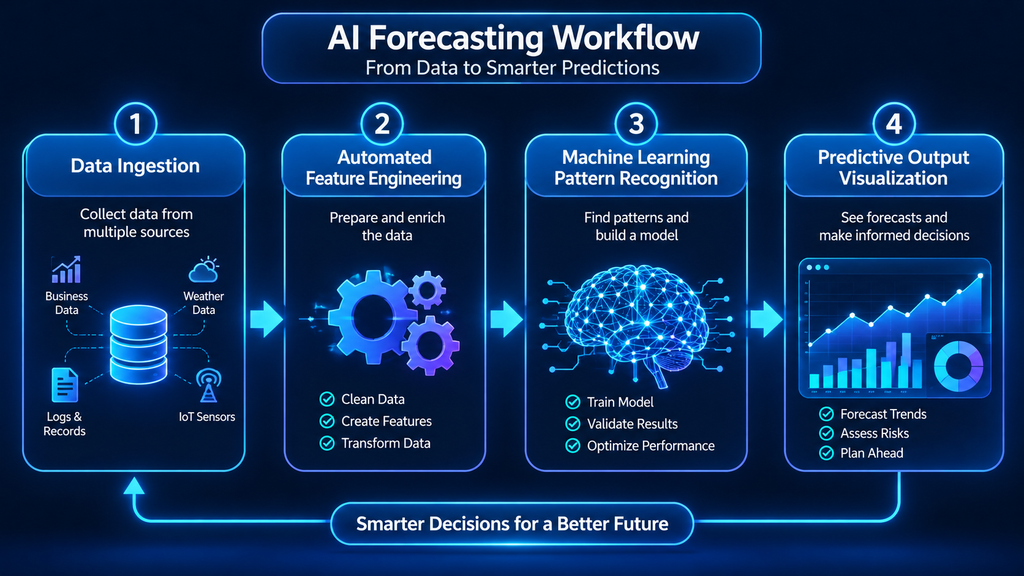
The best model is then placed into a dashboard or planning tool, where it creates new forecasts on a schedule. The work does not stop there, though. Markets and customer habits change, so teams track accuracy over time and retrain the model when it slips. This slow decline is called model drift, and watching for it separates AI forecasting systems that last from those that get abandoned.
Best AI Forecasting Models and Tools to Start With
No single model is best for every job. Domo’s guide recommends testing several approaches on your own data and choosing the winner by measured accuracy instead of reputation. That advice makes sense to me, and it fits well with a simple starting point for beginners.
Why I Recommend Starting With Simple Models
In my view, beginners should start with simple forecasting models such as Prophet and traditional time-series methods. They are easier to understand, they need less setup, and they can give useful results when you have enough history. You also learn more from them, because you can see why a forecast moved up or down.
ARIMA is a classic time-series model. It uses past values and moving averages, trains quickly on limited data, and is easy to interpret. It does assume the data is fairly stable, so it struggles when conditions change suddenly. Prophet, built by Meta, handles holidays, missing values, and outliers well. It splits a forecast into trend, seasonality, and holiday effects, which makes the results simple to explain. Exponential smoothing methods work in a similar way and suit sales and demand data with clear seasonal patterns.
More advanced options exist. Gradient boosting methods like XGBoost work well when many outside factors affect results, such as price, promotions, and weather. Random forests handle noisy data, and LSTM networks can learn from long sequences, such as months of sensor readings. These models are powerful, but several guides warn that deep learning often needs thousands of observations before it beats simpler methods. Starting with a complex model on a small dataset is a common mistake.
So my recommendation is to begin with a simple model and test it against real results. Add complexity only when you can prove the extra accuracy is worth it and your team can still explain the numbers. This keeps AI forecasting practical instead of confusing.
Popular AI Forecasting Tools to Explore
The right tool depends on your skills and your goals. Finance teams that live in spreadsheets often look at Cube, Datarails, or Abacum, which add forecasting and reporting to Excel or Google Sheets workflows. Larger companies with complex planning needs consider Anaplan, Workday Adaptive Planning, or Pigment, which cover finance, workforce, and operations.
If you want to build your own models, Prophet is a free, open-source option, and TensorFlow supports deep learning. H2O AI Cloud and DataRobot offer automated machine learning, which picks and trains models with less manual work. Akkio is a no-code platform for people without a technical background. Zoho Analytics supports several standard models and can choose one automatically based on your data. It also offers what-if analysis, where you move a slider to see how a budget change might affect sales.

I have not tested these tools myself, so I cannot rank them from experience. I can pass along one caution from my research: most articles about tools are written by software companies, and each one ranks its own product first. Amazon Forecast also no longer accepts new customers, so skip it unless you already use it. Whichever tool you consider, ask for a trial and test it on a small slice of your own data first.
Preparing Your Data and Measuring Forecast Accuracy
Data quality sets the ceiling for AI forecasting quality. A smart model fed incomplete or messy records will still give weak predictions. In my opinion, the most common beginner mistake is trusting historical data without checking it. Missing values, seasonal changes, and unusual demand patterns can all distort results. My advice is to clean and understand your data first, start with a simple model, and test its predictions against actual results before making important decisions.
Most guides suggest at least two to three years of history so a model can learn yearly seasonality. Predicting rare events or long-term trends may need five years or more. Older data may matter less if your business changed a lot, for example after a new pricing plan. Detail level matters too. Daily data supports daily forecasts, while weekly data limits you to weekly ones.
Common Data Traps to Avoid
Domo’s guide points out several traps that catch teams again and again:
- Stockout censoring: If a product sold out, past sales understate real demand, so the model will under-forecast unless you flag those periods.
- Data leakage: Training on information you will not have at forecast time, such as final revised sales numbers, makes test results look great and real results look poor.
- Promotional effects: You need to separate normal baseline demand from the extra lift a promotion creates, or you will overpredict future promotions.
- Cold starts: New products have no history, so you can borrow the history of similar products.
Missing values also need a clear plan. Filling gaps with simple averages can add bias, so write down how you handled them. One-time events, like a viral social media post or a data entry error, should be flagged so the model does not treat them as repeatable patterns.
Once your data is ready, you need a way to judge your results. Mean absolute error (MAE) is the average gap between forecast and actual. If it is 50 units, you are off by about 50 units on average. Mean absolute percentage error (MAPE) shows the gap as a percentage, which makes different products easier to compare, but it breaks down when actual values are zero. Weighted absolute percentage error (WAPE) fixes that by dividing total error by total actual demand, so big sellers count more. Root mean square error (RMSE) squares each error first, so large misses hurt more.
A small example shows how they differ. Say actual demand was 100, 150, and 200 units, and the forecasts were 110, 140, and 210. The MAE is 10 units. The MAPE is about 6.1 percent. The WAPE is about 6.7 percent, because the total error of 30 units is divided by 450 units of demand.

How you test matters as much as which metric you pick. Never split time series data randomly, because the model then sees the future during training. Instead, use rolling backtesting. Train on data up to a cutoff date, forecast the next period, move the cutoff forward, and repeat. This gives a more honest picture of how your AI forecasting would have performed in real life. You should also track bias, which is the average signed error. A model with low error but steady bias will slowly pile up too much or too little inventory.
Benefits and Limits of AI Forecasting
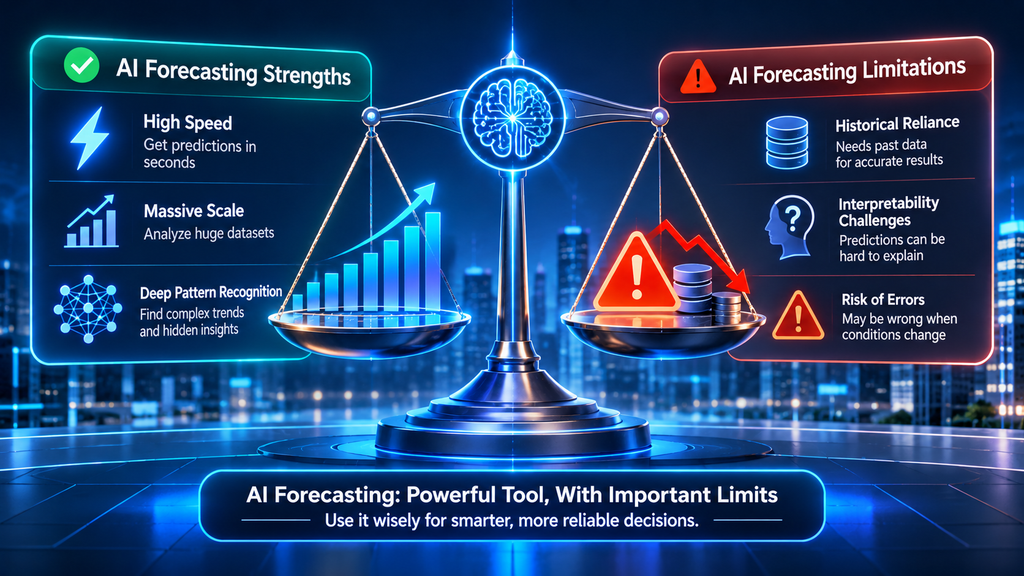
The most direct benefit of AI forecasting is better accuracy, especially when conditions change quickly. One general business guide cites a McKinsey finding that near real-time data updates can cut forecast errors by up to 50 percent. Abacum’s CEO describes error reductions of 20 to 50 percent but gives few details about the source. I would treat these numbers as possibilities, not promises.
Speed is another gain. Automated data refreshes and backtesting shorten planning cycles, so teams can react in days instead of waiting for the next quarterly update. Abacum’s article reports that Groupe Casino saw a 30 percent improvement in forecast accuracy using Google’s Vertex AI, along with four times faster model training.
AI forecasting can also save money. HubSpot cites McKinsey figures saying that in telecom, energy, and healthcare, AI forecasting can automate up to half of workforce-management tasks and cut costs by 10 to 15 percent. Those savings come from avoiding overstock, understaffing, and last-minute rush orders. Scale helps as well, since one model can refresh thousands of forecasts at once. Many tools also show a range of outcomes, so leaders can see best and worst cases instead of a single number.
Where AI Forecasting Falls Short
Poor data is the biggest threat. AI treats whatever you give it as truth, so duplicates, gaps, and biased history flow straight into the forecast. A model trained mostly on sales from one region may underpredict demand in a market the company never served well, because the data reflects past business choices instead of true demand.
Sudden change is another limit. AI forecasting learns from the past, so recessions, pandemics, and supply shocks can break a model trained before the event. Better math does not fix this problem. You need to watch for signs that old patterns no longer hold, keep backup plans ready, and add scenario planning on top of the statistics.
Resources also matter. Good AI forecasting needs skilled people, data pipelines, and ongoing monitoring. No-code tools lower the barrier, but connecting them to your current systems still takes effort. Complex models can be hard to explain to a skeptical manager, and some tools pull in sensitive customer or financial data, so privacy deserves attention. Finally, some teams treat AI forecasting as a “set it and forget it” tool. Predictions with no human review often miss business context, so I suggest naming one person who owns each forecast.
If you are just starting out, here is a practical path. Pick one small forecast, such as weekly sales for a single product. Clean the data, run a simple model, and compare its predictions with what actually happened. Repeat for a few weeks before trusting it with bigger decisions. This approach costs little and teaches you a lot about your data.

Frequently Asked Questions About AI Forecasting
What is the best way for a beginner to start with AI forecasting?
Start small. Choose one thing to predict, such as weekly sales, and gather at least two to three years of clean history if you can. Try a simple model like Prophet or a traditional time-series method first. Compare its predictions with real results before using it for important decisions, and add more advanced models only after you understand how the simple one behaves.
How accurate is AI forecasting?
Accuracy depends on your data, your model, and how stable your business is. Some sources claim error reductions of 20 to 50 percent, and others claim accuracy of 80 to 95 percent, but those figures vary widely and often lack clear sources. The best way to learn what AI forecasting can do for you is to run a small test on your own data and measure the results with a metric like WAPE or MAE.
Can AI forecasting predict events like recessions or pandemics?
Not reliably. AI forecasting learns from past patterns, so rare shocks fall outside what it knows. Pair your forecasts with scenario planning, and keep a person watching for signs that conditions have changed.
Artificial intelligence is increasingly being used in content production, business processes, software engineering, and data analysis.
But building an AI-powered application requires more than choosing a model. Developers also need tools to connect data, manage processing, test results, and deliver useful features.
This is where AI frameworks become valuable. They offer ready-made components that allow developers to build AI applications without creating everything from the beginning.
While working on content planning, keyword analysis, prompt design, and web development, I have explored different AI technologies. These include PyTorch, TensorFlow, LangChain, LlamaIndex, Hugging Face Transformers, Scikit-learn, and OpenCV. In this guide, I will cover how AI frameworks function, compare widely used options, and explain how to choose the right framework for your project.
What Are AI Frameworks?
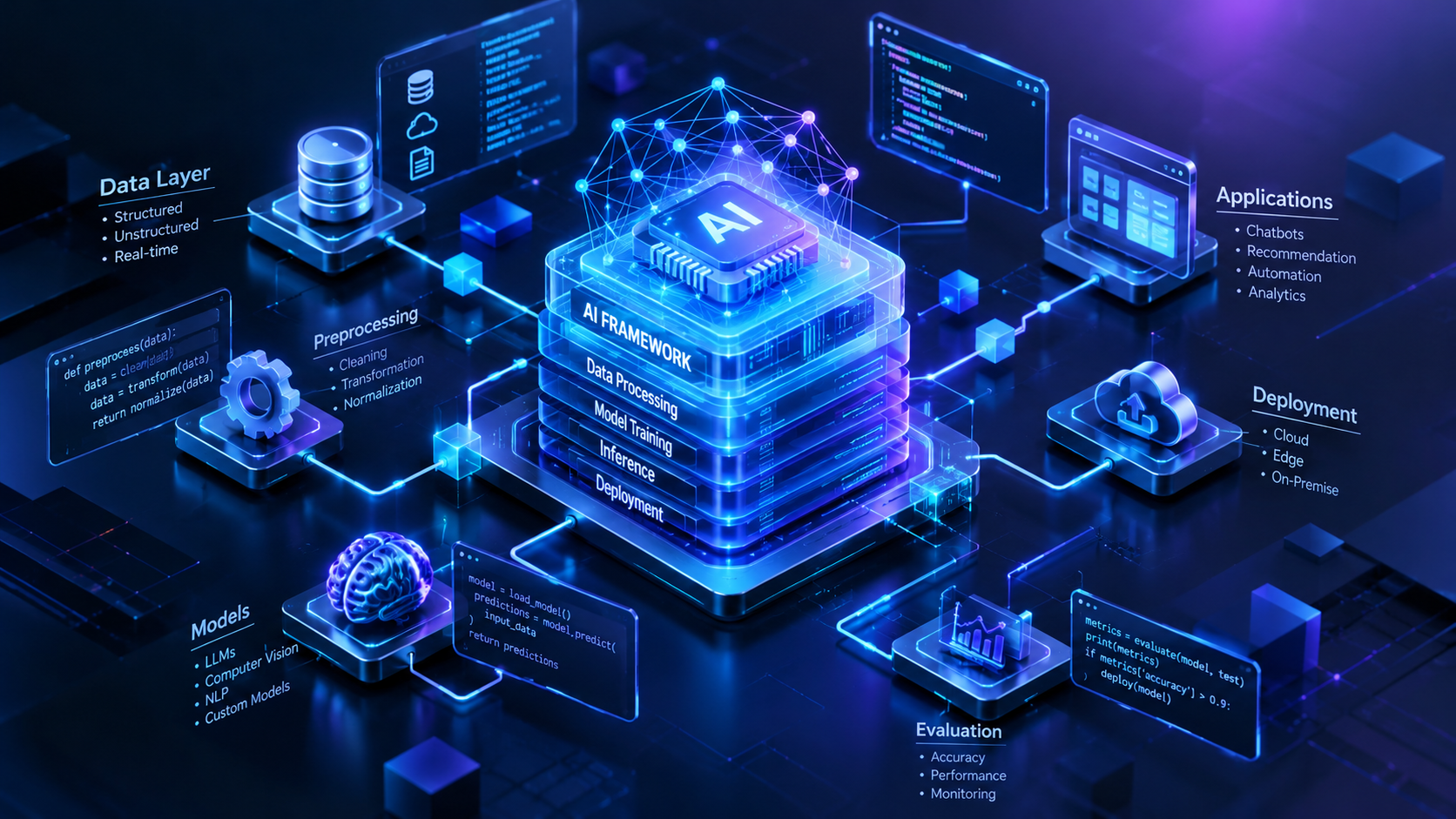
AI frameworks are software tools and libraries that support the development of artificial intelligence applications. Depending on their purpose, they can help developers train models, process information, make predictions, or connect existing models to applications.
For instance, a developer building an image detection application may use a deep learning framework to train a neural network. In contrast, someone developing a chatbot that answers questions from documents may use tools that link a language model with files and databases.
Each AI framework serves a different purpose. Some are designed for machine learning, others support deep learning, and some make it easier to develop applications using large language models.
How Do AI Frameworks Work?
Every AI project usually starts by identifying a problem that needs to be solved. Developers then select appropriate data, models, and software tools.
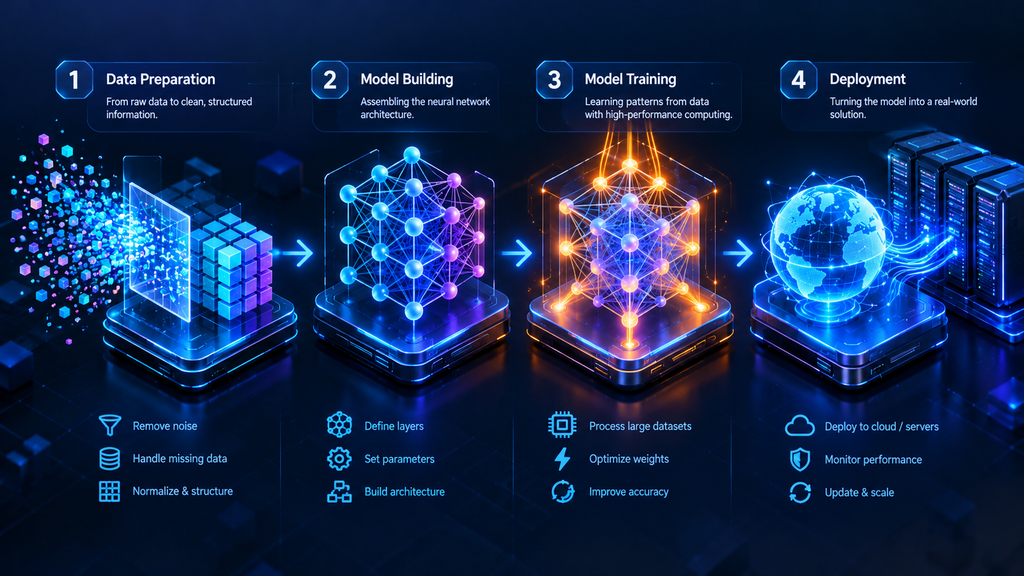
The process often includes three main steps:
- Prepare the information: Prepare and structure text, images, numerical values, and other types of data.
- Build or connect the model: Train a new model, adjust a pre-trained model, or use an existing model through an API.
- Test and deploy: Evaluate the output, connect the solution to an application, and monitor its performance.
AI frameworks provide components for some or all of these stages. However, a project using a hosted AI model may not require training a model itself.
Why Are AI Frameworks Important?
AI frameworks simplify repeated coding tasks, allowing developers to concentrate on addressing the main problem.
Faster development: Ready-made components make it easier to experiment without programming every operation manually.
Simpler testing: Developers can test different models and configurations to choose the option that best suits their requirements.
Integration: Many frameworks integrate with external libraries, APIs, databases, and other development tools.
Flexibility: Some provide greater flexibility for designing model structures, while others simplify the process of working with ready-made models.
Reusable workflows: Development teams can reuse existing components instead of building the same features repeatedly for every project.
However, AI frameworks alone cannot ensure reliable results, strong security, or reduced expenses. These factors depend on the quality of the model, data, infrastructure, and development methods.

Types of AI Frameworks
AI frameworks can be divided into three main groups based on their primary functions.
Deep Learning Frameworks
These frameworks are designed to build and train neural networks that identify patterns in large or complex datasets. They are used in image recognition, language processing, speech systems, and other advanced AI applications.
PyTorch and TensorFlow are major examples. Keras provides a simpler, user-friendly way to develop neural networks.
Traditional Machine Learning Libraries
These tools offer algorithms for tasks such as classification, regression, clustering, and forecasting. They are often useful when working with structured information, such as sales records or customer data. Scikit-learn and XGBoost are widely used tools for these types of tasks.
Generative AI and LLM Frameworks
These frameworks help developers create applications powered by large language models and other pre-trained AI models. They also make it easier to link models with documents, external tools, APIs, and business processes.
LangChain, LlamaIndex, and Hugging Face Transformers support different parts of this process.
8 Popular AI Frameworks and Tools
Different AI frameworks and supporting tools are designed to handle specific tasks and development needs. The best option depends on the type of application you want to create.
1. PyTorch
PyTorch is a deep learning tool that enables developers to create, train, and test neural networks. Its easy-to-use Python interface makes it a popular choice among researchers, software developers, and beginners exploring deep learning.
Based on my experience, I recommend PyTorch to beginners who want to understand model training instead of simply using an existing AI service. Its Python-based syntax makes testing ideas and fixing errors easier for developers.
PyTorch works well for customized deep learning projects, but simpler tasks may not require it if a suitable pre-trained model is already available.
2. TensorFlow
TensorFlow is an open-source framework designed to develop machine learning and deep learning applications. It offers tools for training models and creating AI solutions that can be deployed in real-world environments.
Developers can apply TensorFlow to various tasks, including image recognition, forecasting, and natural language processing.
It may suit projects that need its broader development ecosystem and supported deployment options.
Before selecting TensorFlow, evaluate its features and learning curve against other options, such as PyTorch.
3. Keras
Keras simplifies neural network development through a high-level interface. Developers can set up neural network layers, adjust training settings, and test model performance without coding every underlying process themselves.
It is also a useful entry point for beginners who want to understand deep learning by working on hands-on projects.
4. Hugging Face Transformers
Hugging Face Transformers provides access to pre-trained models for tasks such as text classification, summarization, translation, and question answering.
Pre-trained models have already learned patterns from training data. Developers can apply these models to compatible tasks or customize them to meet specific requirements.
I suggest exploring Hugging Face Transformers if you want to work with pre-trained models rather than develop an entire system from scratch.
Keep in mind that larger models may require considerable computing resources.
5. Scikit-learn
Scikit-learn is a machine learning library designed for everyday prediction and analysis tasks. It provides tools for data preparation, algorithm training, and performance testing.
For instance, a company might use it to group customer records into categories or identify customers who could stop using its services.
Scikit-learn is a suitable option for traditional machine learning projects that rely on structured data.
6. XGBoost
Scikit-learn is a machine learning library designed for everyday prediction and analysis tasks. It provides tools for data preparation, algorithm training, and performance testing.
For instance, a company might use it to group customer records into categories or identify customers who could stop using its services.
Scikit-learn is a suitable option for traditional machine learning projects that rely on structured data.
7. LangChain
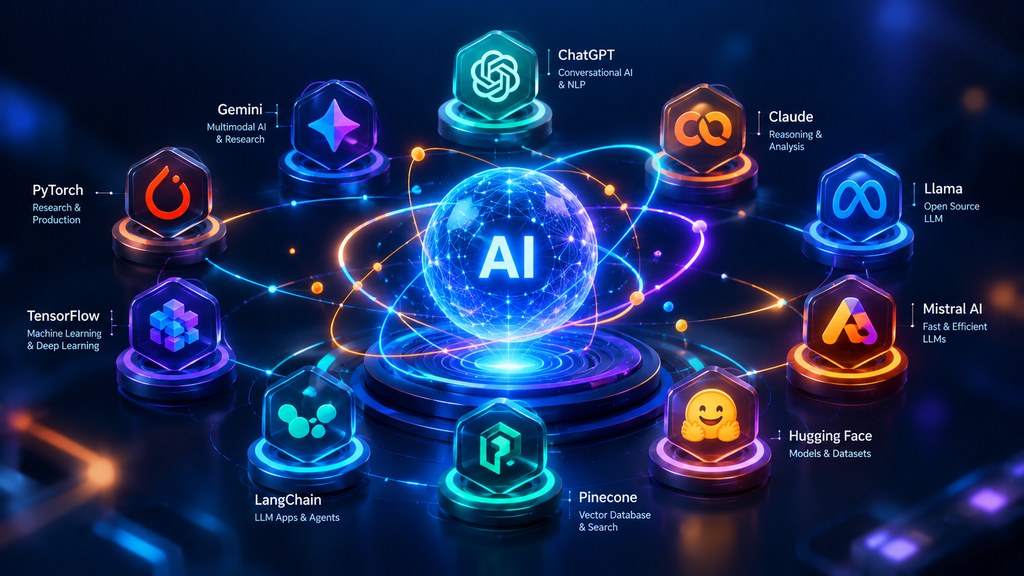
LangChain helps developers connect language models with prompts, external tools, information sources, and application logic. It is useful for building chatbots, document assistants, and retrieval-augmented generation (RAG) applications.
I have used LangChain for RAG pipelines and LLM-powered applications. One project I built was a blog content recommendation and auto-tagging tool using LangChain and OpenAI’s API.
The tool processed long articles, generated relevant SEO tags, and recommended related posts based on semantic similarity rather than exact keyword matches. This helped make content strategy and internal linking faster.
The project shows how AI frameworks can connect a language model to a practical workflow instead of being used only for training models.
8. LlamaIndex
LlamaIndex helps applications access and retrieve information from external data sources. It can be useful when a language model needs to answer questions using documents or other information rather than relying only on its existing knowledge.
I have also used LlamaIndex for RAG pipelines and LLM-powered applications. When comparing LlamaIndex with LangChain, consider your retrieval needs, integrations, and the structure of your application.
A useful distinction: OpenAI’s API provides access to supported AI models, while tools such as LangChain can help organize model calls and connect them to other parts of an application. They can be used together, as in my content recommendation project.
Real-World Uses of AI Frameworks
AI frameworks support applications across different industries. Their role depends on the data, model, and problem involved.
Healthcare
AI systems can assist with medical image analysis, research, and administrative tasks. Healthcare applications require careful testing, privacy safeguards, and professional oversight.
Retail and Ecommerce
Businesses can use AI for product recommendations, demand prediction, customer analysis, and product categorization. Recommendation systems can identify relevant relationships between products and customer interests.
Finance
Machine learning models can help detect unusual transactions, assess risk, and identify potential fraud. Reliable results require suitable data and continuous evaluation.
Education
AI-powered applications can help generate learning materials, answer questions, and adapt educational content. Accuracy and student privacy remain important considerations.
Agriculture
AI can help analyze crop images, identify possible plant problems, and support predictions about crop conditions. Results depend on the quality of the data and local conditions.
Content and Business Workflows
AI frameworks can support document analysis, content classification, automated tagging, and internal information retrieval.
My blog recommendation project is one example. By combining LangChain with OpenAI’s API, I created a workflow that could identify related articles and suggest SEO tags. Similar approaches may help content teams organize large collections of posts more efficiently.

How to Choose the Right AI Framework
Choosing among AI frameworks becomes easier when you start with your project’s requirements.
Identify Your Goal
First, decide what you need to build. For neural network training, consider PyTorch or TensorFlow. For traditional machine learning, look at Scikit-learn or XGBoost. For applications using language models and external information, consider LangChain, LlamaIndex, or Hugging Face Transformers.
Consider Your Skills
Some AI frameworks require knowledge of model architecture and training. Others focus on connecting existing models to applications.
If you want to learn deep learning, PyTorch is a reasonable starting point. If your goal is to build an application with an existing model, an API and an appropriate integration library may be more practical.
Check Compatibility and Cost
Make sure your chosen tools work with your programming language, data sources, APIs, and deployment environment.
Also consider hosting, computing resources, API charges, and ongoing maintenance. Open-source software may be free to use under its license, but running a project can still involve costs.
Review Security and Privacy
Check how your application handles sensitive documents, credentials, and user information. If you use external AI services, review their data-handling terms and applicable privacy requirements.
Build a Small Prototype
Test your idea before developing a complete system. Use realistic examples to check whether the chosen tools provide useful results.
A small prototype can reveal limitations in data quality, model accuracy, integrations, and performance before you invest more resources.
Challenges of Using AI Frameworks
Although AI frameworks simplify development, they also introduce challenges.
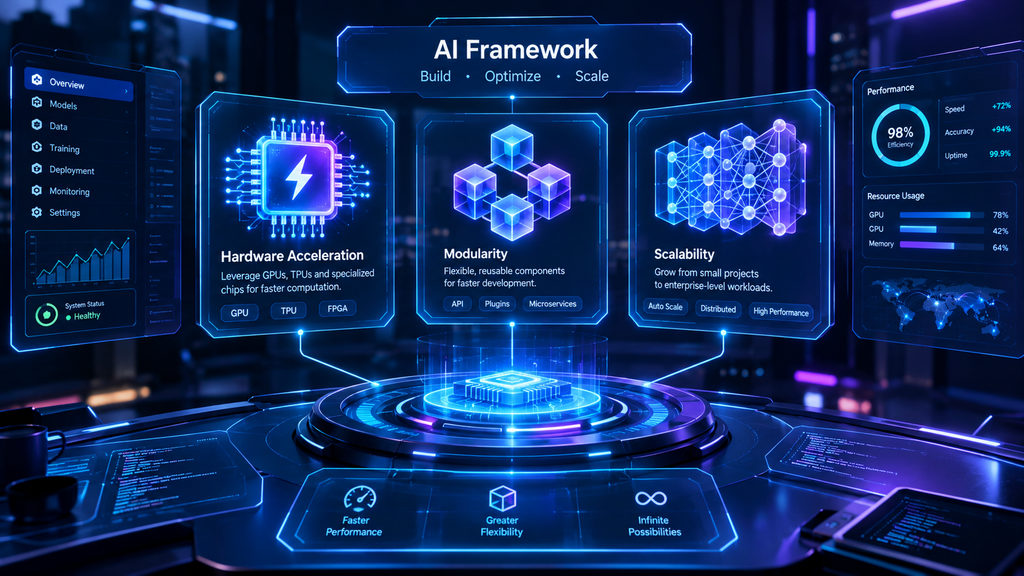
- Learning requirements: Some libraries have complex features that take time to understand.
- Compatibility: Different versions of models and dependencies may cause integration problems.
- Computing resources: Training large models can require powerful hardware and substantial processing time.
- Data quality: Poor data can lead to unreliable predictions, even when the framework works correctly.
- Security: Applications must protect credentials and prevent inappropriate access to sensitive information.
- Maintenance: Deployed systems need testing, updates, and monitoring as requirements change.
Choosing the right framework is only one part of building a reliable AI solution. Developers must also test outputs, document limitations, and protect the data their applications use.
Best Practices for AI Development
To get more value from AI frameworks, follow a clear development process:
- Define the problem before selecting tools.
- Use relevant and reliable data.
- Test models against realistic examples.
- Compare alternatives instead of assuming one tool is best.
- Track important model and dependency versions.
- Protect private information and API credentials.
- Monitor deployed applications for errors and performance changes.
- Document what the system can and cannot do.
For applications using external documents, check whether the retrieval process finds relevant information. For predictive systems, evaluate performance using suitable test data.
These steps help developers understand the limits of their systems and make improvements when needed.
Frequently Asked Questions
1. What are AI frameworks used for?
AI frameworks help developers build, train, test, and deploy AI applications. Depending on the tool, they can support neural networks, predictions, image processing, chatbots, and document-based question-answering systems.
2. Which AI framework is best for beginners?
PyTorch is a good option for people who want to learn deep learning. Beginners building applications with existing language models may prefer tools such as LangChain and Hugging Face Transformers. The best choice depends on the project and the skills you want to develop.
3. Are AI frameworks free?
Many AI frameworks, including PyTorch, TensorFlow, and Scikit-learn, are available as open-source software. However, computing, hosting, commercial services, and API usage may involve additional costs. Always check the license and pricing of the tools you plan to use.
Final Thoughts
AI frameworks help turn AI capabilities into useful applications by providing tools for model development, prediction, and integration. PyTorch and TensorFlow support deep learning, Scikit-learn and XGBoost handle many traditional machine learning tasks, and LangChain and LlamaIndex help build applications around language models and external information.
My recommendation is to start with the problem you want to solve. Choose a suitable framework, test a small project, and expand only when the approach meets your needs. This keeps development focused and helps you select tools based on practical requirements rather than popularity.

Artificial intelligence is changing how developers build websites, apps, and software. Today, AI tools can generate code, explain errors, and help developers create applications from simple instructions. However, choosing the right AI programming languages is still important because each language offers different features, tools, and performance levels.
During my university e-commerce website project, I used ChatGPT with VS Code to create website pages, work with HTML, CSS, and JavaScript, and find coding errors. AI helped me understand problems and move forward, but the generated code sometimes needed corrections. This experience showed me that AI can support development, but programming knowledge is still necessary.
In this guide, we’ll explore the best AI programming languages, their practical uses, popular AI coding tools, and how to choose the right option for your project.
What Are AI Programming Languages?
AI programming languages are computer languages used to develop applications that can learn from data, recognize patterns, make predictions, or perform intelligent tasks. Developers use these languages to build machine learning models, chatbots, recommendation systems, and other AI-powered applications.
Python, Java, R, Julia, and C++ are common examples. Each language has different strengths. Python is popular for machine learning, R is useful for statistical analysis, and C++ supports applications that need high performance.
The right choice depends on what you want to build. You do not need to learn every language before starting with AI. Understanding one suitable language and its tools is often enough to begin.

How Programming Languages Support AI Development
AI systems require more than code. They also need data, computing resources, libraries, testing, and deployment tools. Programming languages connect these parts and help developers turn an idea into a working application.
For example, an online store might use Python to analyze sales data and recommend products to customers. The recommendation model could then connect to the website through an application interface.
Libraries make this process easier. TensorFlow and PyTorch support machine learning and deep learning, while scikit-learn provides tools for classification, regression, and clustering.
When choosing AI programming languages, consider the complete project, including how the model will be tested, deployed, updated, and maintained.
Best Programming Languages for AI Development
Different AI programming languages serve different needs. Python is a practical starting point for many projects, while other options are useful for statistical research, enterprise software, web development, or high-performance computing.
Python for Machine Learning and Deep Learning
Python is one of the most widely used AI programming languages because it has readable syntax, a large community, and many helpful libraries. Beginners can learn its basic structure without dealing with too many complex rules.
Python supports machine learning, deep learning, data analysis, automation, and natural language processing. TensorFlow and PyTorch help developers build neural networks, while scikit-learn supports common machine learning tasks.
For example, a retailer could use Python to study previous sales and predict which products customers may purchase next. Developers can test an idea quickly and improve it as they learn more about the data.
I recommend Python for beginners because its libraries and learning resources make it easier to start building practical AI projects.
R for Statistical Analysis and Data Visualization
R is designed mainly for statistics, data analysis, and visualization. It is useful for research projects that require careful examination of numbers, trends, and relationships.
Packages such as ggplot2 help create charts, while caret and randomForest support predictive modeling. Researchers can use these tools to study patterns and present findings clearly.
For example, a marketing team could analyze campaign results to compare customer responses and identify trends. R is especially valuable when statistical analysis is the main goal, although it is less common than Python for general AI application development.
Java for Enterprise AI Applications
Java is a mature programming language used in enterprise software, web applications, and large-scale systems. Its cross-platform support and strong development tools make it useful for organizations that need reliable applications.
Java can support recommendation systems, data processing, and AI features that connect with existing business software. Libraries such as Deeplearning4j provide tools for deep learning, while Apache Spark supports large-scale data processing.
For example, a retailer with an existing Java-based inventory system may choose Java-compatible tools to add intelligent stock predictions without rebuilding the entire application.
Julia for High-Performance AI Computing
Julia is designed for numerical analysis, scientific computing, and demanding calculations. It combines readable syntax with performance-focused features, making it useful for simulations and complex mathematical models.
Julia supports scientific research, machine learning, and quantitative finance. Its parallel computing capabilities can help with tasks that involve many calculations.
However, Julia has a smaller library ecosystem than Python. It is worth considering when performance and numerical computing matter more than having the widest selection of ready-made AI tools.

C++ for Performance-Critical AI Systems
C++ is known for speed and control over computer resources. It is useful for robotics, computer vision, game development, and AI systems that must respond quickly.
For example, a robot may need to process sensor data and react to its surroundings with very little delay. C++ can help developers build efficient components for these tasks.
C++ is more challenging for beginners because it requires a stronger understanding of memory and program structure. Python is usually easier to learn first unless a project specifically requires C++.
JavaScript for Web-Based AI Applications
JavaScript makes websites interactive and can connect AI features to web applications. Developers use it to build interfaces for chatbots, product recommendations, and intelligent search features.
For example, an online store could offer a chatbot that answers product questions. JavaScript can manage the chat interface while a server processes requests using an AI model.
JavaScript is useful for bringing AI features to users through websites, even when the underlying model is developed in Python.
Lisp and Prolog for Symbolic AI and Logic-Based Systems
Lisp and Prolog are associated with symbolic AI, where systems work with facts, rules, symbols, and logical relationships.
Lisp supports symbolic computation and flexible program structures. Prolog allows developers to define facts and rules that a system uses to search for possible answers.
For example, a rule-based expert system could use defined conditions to help identify possible causes of a technical problem. These languages are more specialized than Python but remain useful for understanding logic-based AI.
Haskell for Reliable and Functional Programming
Haskell is a functional programming language that focuses on clear expressions, strong types, and predictable behavior. It is used in areas such as compiler development, scientific computing, and formal verification.
Its type system can help detect certain errors before a program runs. Although Haskell is not a common first choice for general AI development, it can be useful when reliability and clear program behavior are important.
Swift, Go, and Rust for Specialized AI Applications
Swift, Go, and Rust serve different purposes in AI development.
Swift is useful for building AI-powered iPhone and iPad applications within Apple’s ecosystem. Go supports concurrent processing and can help manage data pipelines and distributed services. Rust focuses on performance and memory safety, making it useful for systems that need efficient resource management.
These AI programming languages show that AI development includes more than model training. Developers also need to build applications, connect services, and deploy systems reliably.
How AI Programming Languages Are Used in Natural Language Processing
Natural language processing (NLP) allows computers to analyze, understand, and generate human language. It supports chatbots, text summaries, document search, translation, and sentiment analysis.
Python is widely used for NLP because it has libraries designed for text processing and language models. NLTK provides tools for tasks such as tokenization, while spaCy supports efficient text analysis and named entity recognition.
The Hugging Face Transformers library helps developers work with models such as GPT and BERT. These models can support tasks like answering questions, summarizing documents, and generating text.
For example, an online store could analyze customer reviews to identify common complaints or use a chatbot to answer product questions. Python is a practical choice for building these features, while JavaScript can connect them to a website.

What Is AI Code Generation?
AI code generation uses artificial intelligence, especially large language models, to create computer code from natural language instructions or existing code. Developers can describe a task and ask an AI tool to produce a starting version.
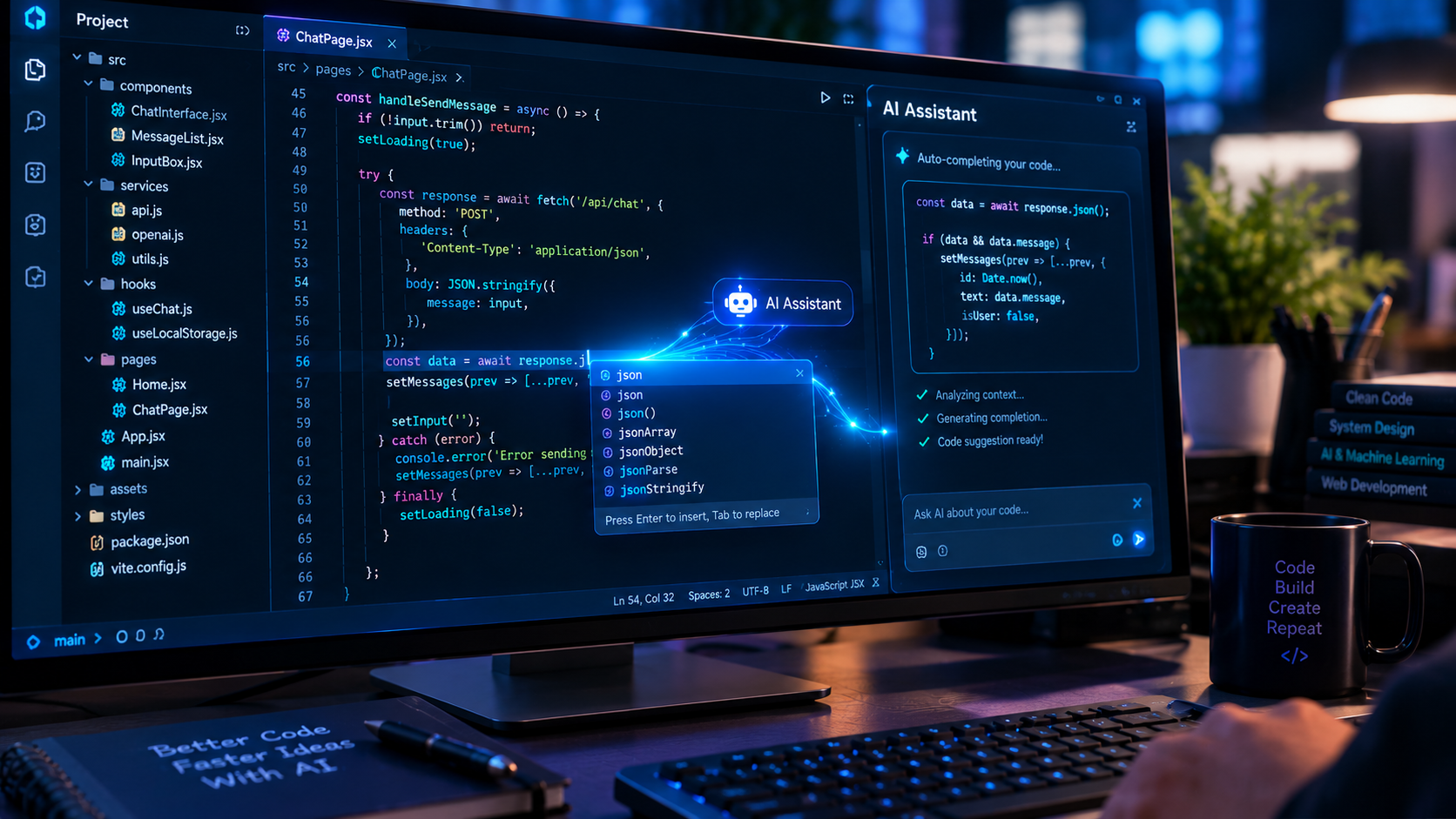
For example, you could ask ChatGPT to create an HTML form, explain a JavaScript function, or help find an error in a program. AI tools can also translate code, improve readability, generate documentation, and suggest fixes.
During my e-commerce project, ChatGPT helped me work on website pages and understand coding errors. However, I still needed to review and correct the generated code. Treat AI-generated code as a draft, not a guaranteed final solution.
How AI Code Generation Works
AI coding models learn patterns from large collections of code and text. When a developer enters a prompt, the model uses the instructions and available context to generate a code suggestion.
Clear prompts usually produce more useful results. Instead of asking an AI tool to build an entire website, describe one feature, the expected behavior, and the language you want to use.
Work in small steps. Generate a feature, inspect the code, run it, and fix any problems before moving forward. This approach makes errors easier to identify and reduces the risk of damaging other parts of the project.
Benefits of AI Code Generation
AI coding tools can support developers by reducing routine work, explaining unfamiliar code, and helping them test ideas.
Faster Software Development
AI can generate common code structures, forms, API examples, and basic functions. Developers can review these suggestions instead of starting every task from an empty file.
For example, you could ask for a product card layout and then adjust its design to match your website. The actual time saved depends on how complex the task is and how much correction the code needs.
Improved Developer Productivity
AI assistants can explain errors, suggest fixes, and help developers understand unfamiliar projects. This can reduce time spent searching for solutions.
In my experience with the e-commerce project, ChatGPT helped when I needed to understand coding problems. Still, checking the suggestions was essential. AI works best when it supports your decisions rather than making them for you.
More Accessible Coding and Prototyping
AI code generation can help beginners create small prototypes while learning programming concepts. You can ask for an example and then request an explanation of each part.
For instance, a beginner could generate a contact form and learn how HTML creates the fields, CSS styles them, and JavaScript checks the input.
However, building a reliable application requires more than generating a first draft. You still need to understand the code, test its behavior, and maintain it.

Challenges of AI Code Generation
AI tools can produce useful code, but their output may contain mistakes, security weaknesses, or features that do not meet project requirements.
Code Quality and Accuracy
AI-generated code may contain bugs, repeated instructions, incorrect logic, or outdated methods. Developers should run the code, test different inputs, and check whether the output matches the expected result.
Unit tests can check individual functions, while integration tests help confirm that different parts of an application work together.
Security Risks in AI-Generated Code
Generated code can introduce unsafe input handling, weak access controls, or poor data protection. These issues are especially important for applications that handle customer information or payments.
Review security-related code carefully, follow secure coding practices, and never share passwords or private keys in prompts. AI assistance does not replace security testing.
Maintaining Programming Skills and Human Oversight
Depending too much on AI may limit opportunities to practise coding and problem-solving. Beginners can also struggle to fix errors if they do not understand the generated code.
Ask AI to explain its solution, make small changes yourself, and test the results. Developers remain responsible for the quality, safety, and reliability of the software they deliver.
Best AI Code Generation Tools for Developers
Different tools support different workflows. Some provide suggestions inside a code editor, while others can help with larger development tasks.
Claude Code
Claude Code helps developers understand projects and make changes across multiple files. It can support terminal-based workflows and work with supported code editors.
OpenAI Codex
Codex helps developers generate code, explain complex logic, investigate potential bugs, and suggest fixes. Its usefulness depends on the task, available project context, and the developer’s review.
Cursor
Cursor provides AI-assisted coding, codebase search, feature planning, and debugging. It can help developers understand how different files relate to one another.
GitHub Copilot
GitHub Copilot offers inline code completion and chat-based assistance in supported development environments. It can suggest code as you type and help explain programming questions.
Google Antigravity
Google Antigravity supports AI-assisted development tasks such as code generation, refactoring, and unit-test creation. Developers should inspect changes and test the results.
IBM Bob
IBM Bob helps with code generation, documentation, code explanations, and software modernization. It can support teams working with existing applications and development workflows.
Tabnine
Tabnine provides AI code completion and coding assistance, with an emphasis on privacy and enterprise deployment options. Teams should review its current privacy policies before using it with confidential code.
ChatGPT and Google Gemini for Code Generation
ChatGPT and Gemini can generate code, explain programming concepts, and help investigate errors through text prompts. They are useful for beginners and developers who want to explore solutions.
I used ChatGPT alongside VS Code during my website project. I could request code, test it in the editor, and ask for help when errors appeared. This step-by-step process was more useful than accepting a large block of code without checking it.
AI Code Generation vs. Low-Code and No-Code Development
Low-code and no-code platforms use visual tools, templates, and ready-made components to help users create applications with little manual coding.
AI code generation works differently. It uses natural language instructions to produce code that developers can inspect and modify.
For example, a business user might build a basic form using a no-code platform. A developer might use AI to generate a custom form with specific validation rules and then adjust the code to fit the application.
The best approach depends on your needs. Visual platforms can suit simple workflows, while AI code generation offers more flexibility for custom software. Both require suitable checks when reliability and security matter.
How to Choose the Right AI Programming Language for an AI Project
The best AI programming languages depend on your goals, skills, and technical requirements. Consider these four factors before choosing one.
Performance and Speed Requirements
Python is suitable for many machine learning tasks, while Julia supports numerical computing. C++ and Rust can be useful when an application requires fast execution and close control over resources.
Test performance with realistic workloads rather than assuming a language will always be faster for your specific project.
Ease of Use and Team Expertise
Python is a practical choice for beginners because its syntax is readable. JavaScript is useful for web development, while Java may fit teams already working with enterprise systems.
I recommend learning one language well before trying to master several. Once you understand basic programming concepts, learning another language becomes easier.
Libraries, Frameworks, and Community Support
Check whether the language has suitable libraries, clear documentation, and active support for your task. Python offers tools such as TensorFlow, PyTorch, and scikit-learn, while R has strong statistical and visualization packages.
Good library support can reduce development effort and help you solve problems more easily.
Scalability, Deployment, and Integration
Consider where your application will run and how it will connect with existing software. Java can support enterprise systems, JavaScript can connect AI features to websites, and Swift can support apps for Apple devices.
Plan for testing, updates, security, and maintenance from the beginning. A successful AI application must continue working after its first release.
The Future of AI Programming Languages and Code Generation
AI coding tools are moving beyond basic suggestions toward workflows that can edit files, write tests, and help investigate errors. These changes may reduce routine work, but developers still need to understand software design, testing, data handling, and security.
Different languages will continue to serve different purposes. Python remains a strong option for many AI tasks, while Java, C++, Rust, JavaScript, and other languages support specific development and deployment needs.
For beginners, the best path is to learn programming fundamentals, build a small project, and use AI as a learning partner. Test each important change and understand what the code does before relying on it.
Frequently Asked Questions For AI Programming Languages
1. Which programming language is best for AI beginners?
Python is a strong starting point because it has readable syntax, learning resources, and libraries for machine learning and data analysis. You can learn other AI programming languages later when your projects require them.
2. Can AI generate code without programming knowledge?
Yes, AI tools can create code from plain-language instructions. However, you still need to test the results, identify errors, and understand whether the code meets your needs. Basic programming knowledge makes AI tools much more useful.
3. Will AI code generation replace programmers?
AI code generation can automate routine tasks, but developers are still needed to plan applications, review code, test features, and protect user data. AI is best used as an assistant rather than a replacement for human judgment.
Conclusion
The right AI programming languages depend on the project. Python is a useful starting point for machine learning, R supports statistical analysis, Java suits enterprise applications, and Julia helps with demanding numerical work. Other languages offer advantages for web development, robotics, and specialized systems.
AI code generation can make development easier, as I experienced while building my e-commerce website with ChatGPT and VS Code. However, generated code still needs testing and correction. Start with one suitable language, practise regularly, and use AI tools to support your learning while staying responsible for the final result.
-

 AI in Digital Marketing1 month ago
AI in Digital Marketing: Practical Uses, Benefits, and Strategies
-

 AI Applications4 weeks ago
AI Content Optimization: What It Is and Why It Matters
-

 AI Technologies4 weeks ago
AI in App Development: How to Build the Best Apps From Idea to Production
-

 AI Applications3 weeks ago
AI in Gaming: Uses, Benefits, Examples, and Future Trends
-
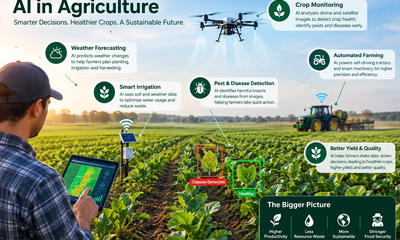
 AI in Agriculture1 month ago
AI in Agriculture: Uses, Benefits, Challenges, and Future Trends
-

 AI Applications3 weeks ago
AI Personalization: Smarter Marketing That Converts
-

 AI Applications4 weeks ago
AI in Construction: Uses, Benefits, Tools, Challenges, and Future Trends
-

 AI Technologies4 weeks ago
AI in Cybersecurity: Uses, Benefits, Risks, and Future Trends