
AI in Agriculture
AI in Agriculture: Uses, Benefits, Challenges, and Future Trends

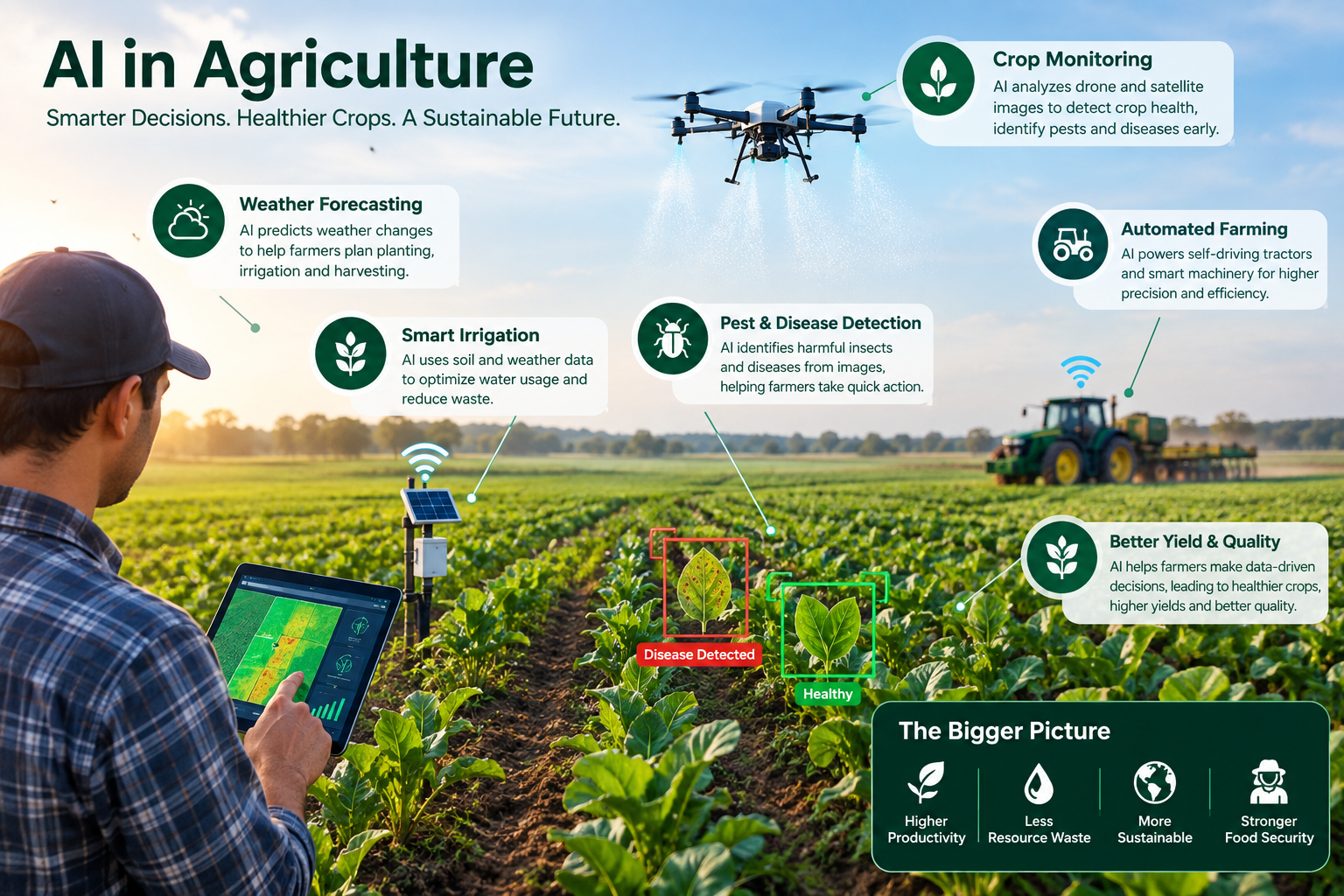
Agriculture is changing quickly. Farmers now have access to satellite images, drones, sensors, smart machines, and artificial intelligence (AI) that can help them make better decisions.
But what can AI actually do on a farm? Can it identify a plant disease, predict crop yields, reduce water use, or help farmers decide when to plant?
The answer is yes. AI is already being used for many of these tasks. It can analyze large amounts of data from crops, soil, weather, sensors, and satellite images and turn that information into useful recommendations.
I have also used ChatGPT to help identify a plant disease. I uploaded a picture of a maize plant, and ChatGPT identified the likely disease and provided information about possible solutions. This gave me a practical example of how AI can make agricultural information easier to access. At the same time, I would not treat an AI answer as a final diagnosis without checking it, especially when the wrong treatment could damage a crop.
In this guide, we will look at the main uses of AI in agriculture, its benefits and challenges, and what the future may look like.
What Is AI in Agriculture?
AI in agriculture means using artificial intelligence to analyze information and help with farming decisions and tasks.
AI systems can work with data collected from:
- Soil sensors
- Weather stations
- Drones
- Satellite images
- Farm machinery
- Cameras
- Crop records
- Market data
Machine learning can find patterns in this data, while computer vision can analyze images of plants, soil, livestock, and fields.

For example, an AI system may analyze an image of a crop and identify signs of disease. Another system may study soil moisture and weather conditions to recommend when irrigation is needed.
The main goal is not simply to add technology to farming. It is to help farmers use resources more efficiently and make better-informed decisions.
How AI Is Used in Agriculture
Precision Farming and Crop Monitoring
AI in agriculture helps farmers monitor crops closely and use resources more efficiently. Precision farming uses data to understand what is happening in different parts of a field.
Instead of treating an entire field in the same way, farmers can use AI to identify areas that need more water, fertilizer, or attention.
AI can combine satellite or drone images with information about soil, weather, and crops. This can help farmers detect crop stress and understand how plants are developing.
This approach can reduce unnecessary use of water, fertilizer, and other inputs.
Pest and Disease Detection
AI in agriculture helps farmers detect pests early and make better decisions to protect crops. Plant diseases and pests can spread quickly if they are not detected early.
AI-powered computer vision can analyze photographs or camera images of plants and look for signs of disease, pests, or crop damage.
My own experience gave me a simple example of this. I uploaded a picture of a maize plant to ChatGPT to find out what disease it might have. ChatGPT identified the likely disease and gave information about possible solutions.
However, this experience also shows an important limitation. An AI model can provide useful guidance, but farmers should not automatically treat its answer as a confirmed diagnosis. Checking the result with a qualified agricultural professional can be important before applying chemicals or other treatments.
Crop Yield Prediction
AI in agriculture helps predict crop yields and improve overall farm production. Farmers need to estimate how much they may produce before harvest.
AI can analyze historical crop data, weather conditions, soil information, satellite imagery, and crop health to estimate potential yields.
Yield predictions can help farmers plan harvesting, storage, transportation, and sales.
The earlier farmers understand possible production levels, the easier it can be to prepare for the next steps.
Smart Irrigation
AI in agriculture helps provide the right amount of water based on crop and soil needs. Water is one of the most important resources in agriculture, and unnecessary irrigation can waste it.
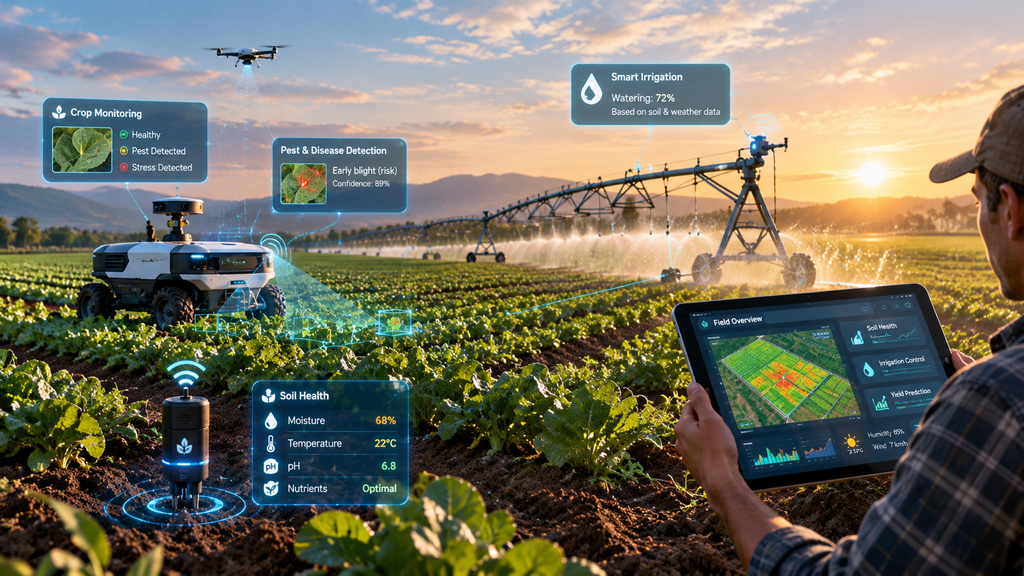
AI can analyze soil moisture, weather forecasts, crop conditions, and historical information to help determine when and how much water is needed.
Smart irrigation systems can then adjust watering based on the conditions of the field.
This can help reduce water waste while giving crops the water they need.
Soil Health Monitoring
AI in agriculture helps farmers monitor soil conditions and make better decisions about crop growth. Healthy soil is essential for healthy crops.
AI can combine soil data with information about crops, weather, and previous farming activities to help identify changes in soil conditions.
Farmers can use this information to make better decisions about fertilizer, irrigation, crop selection, and other field activities.
Instead of relying only on general assumptions about a field, farmers can use data to understand its specific needs.
Farm Decision Support Systems
Farming involves many decisions. When should a crop be planted? How much fertilizer should be used? When should irrigation begin? Is the weather suitable for a particular activity?
AI-based decision support systems can bring different types of information together and provide recommendations.
Some systems can also provide information through natural-language or voice-based interfaces, making agricultural information easier to access.
Still, the farmer remains important. AI can support a decision, but local knowledge and real-world conditions should also be considered.
Agricultural Risk Management
Farmers face many risks, including drought, extreme temperatures, pests, diseases, and changing market conditions.
AI can analyze weather, crop, soil, and historical data to identify potential risks.
For example, predictive models can help estimate the possible effect of unfavorable weather on a crop.
This gives farmers more time to prepare rather than reacting only after a problem occurs.
Autonomous Machinery and Robotics
AI is also being used in agricultural machinery and robots.
Autonomous machines can help with activities such as planting, weeding, crop monitoring, harvesting, and spraying.
Computer vision can help machines distinguish crops from weeds. This allows treatment to be more targeted instead of applying the same treatment across an entire field.
Robotics can be especially useful for repetitive tasks, although the cost of advanced machinery can make adoption difficult for smaller farms.
Post-Harvest Quality Control
AI does not stop being useful when crops are harvested.
Computer vision can inspect agricultural products for size, color, defects, and quality. Automated systems can then help sort or grade products.
This can make quality control faster and more consistent.
Supply Chain and Demand Forecasting
Agriculture also depends on what happens after production.
AI can analyze sales, market, inventory, weather, and demand information to help predict how much of a product may be needed.
Better forecasting can help reduce overproduction, shortages, food waste, and supply-chain problems.
Benefits of AI in Agriculture
AI in agriculture helps farmers improve productivity, save resources, and make smarter farming decisions.
Increased Efficiency and Productivity
AI can automate repetitive work and help farmers identify problems earlier.
Better decisions about irrigation, fertilizer, pests, and harvesting can potentially improve productivity while reducing unnecessary work.

Sustainable Resource Management
AI can help farmers use water, fertilizer, pesticides, fuel, and other resources more carefully.
For example, precision systems can identify where an input is actually needed instead of applying the same amount everywhere.
Better Data-Driven Decisions
Agriculture has always depended on experience and observation. AI adds another source of information.
Instead of relying only on what can be seen in the field, farmers can also use data from sensors, satellites, weather systems, and historical records.
This can make some decisions more informed and measurable.
Reduced Waste and Operating Costs
When farmers use inputs more precisely, they may reduce unnecessary spending and waste.
AI can also help detect problems earlier, which may prevent a small crop issue from becoming a larger one.
However, these benefits depend on the quality of the AI system, available data, farm conditions, and how the technology is used.
Challenges of AI in Agriculture
High Initial Investment
AI in agriculture can require high initial investment, especially for advanced tools and equipment.AI technology can require expensive sensors, drones, machines, software, internet connectivity, and other equipment.
Large farms may find these investments easier to manage than small farms.
For wider adoption, AI solutions need to provide clear value and be affordable for farmers with different budgets.
Data Privacy and Security
AI in agriculture requires secure data systems to protect sensitive farm and farmer information. AI systems depend on data, and agricultural data can include information about fields, production, equipment, and business activities.
Farmers need to understand who owns this data, how it is stored, and who can access it.
Security is also important because connected farming equipment and systems can create new cybersecurity risks.

Technical Expertise and Training
Using AI is not always as simple as installing an application.
Farmers and agricultural workers may need training to understand AI recommendations, operate equipment, interpret data, and identify when a system may be wrong.
Technology is most useful when people understand how to use it properly.
Integration With Existing Equipment
AI in agriculture can be difficult to integrate with existing farming equipment and systems. Many farms already use machinery and systems that were purchased years ago.
Connecting new AI technology with older equipment can be difficult or expensive.
AI adoption therefore needs to consider the technology a farm already has instead of assuming that every farmer can replace their existing equipment.
Future of AI in Agriculture
AI and IoT-Connected Farms
The future of farming will likely involve more connected devices.
Sensors, machines, drones, weather stations, and farm management software can collect information continuously.
AI can analyze this information and provide farmers with a more complete picture of what is happening on the farm.
More Advanced Predictive Analytics
AI models will continue to improve at predicting crop yields, weather risks, pest outbreaks, diseases, and market conditions.
The goal is to identify potential problems earlier and give farmers more time to respond.
Autonomous and Intelligent Farming
AI in agriculture can support autonomous machines that perform farming tasks with less human effort. Agricultural machines are becoming more capable of operating with less human control.
In the future, we may see more autonomous equipment that can monitor crops, identify weeds, apply inputs, and perform other farm tasks.
However, fully autonomous farming will still depend on reliable technology, good data, safety systems, and affordable equipment.
AI for Climate Resilience and Sustainability
AI in agriculture can help farmers respond to climate change and use resources more sustainably. Climate change creates additional pressure on agriculture.
AI can help farmers understand changing weather patterns, identify risks, improve water management, and choose strategies that may help crops deal with difficult conditions.
AI is also being explored in areas such as crop breeding, where data and predictive models can help researchers develop crops with useful characteristics.

Conclusion
AI in agriculture is making farming smarter, more efficient, and more productive.AI is becoming a practical tool for agriculture, from identifying crop diseases and monitoring fields to predicting yields and managing irrigation.
But AI is not a replacement for farmers. A recommendation is only useful when it is based on good data and applied correctly.
My experience of using ChatGPT to identify a possible disease in a maize plant showed me how easily AI can provide agricultural information from a simple image. At the same time, it is a reminder that AI answers should be checked before making important farming decisions.
For farmers considering AI, the best approach is to start with a specific problem. Test one useful application, measure the results, and then decide whether it is worth expanding.
The future of agriculture will likely combine human farming knowledge with AI, data, sensors, and automation. The strongest results will come from using technology as a tool to support better decisions, not as a replacement for human judgment.
Frequently Asked Questions About AI in Agriculture
How is AI used in agriculture?
AI is used to monitor crops, detect plant diseases and pests, predict crop yields, manage irrigation, analyze soil conditions, operate agricultural machinery, and forecast market demand. It can analyze data from sensors, drones, satellites, weather systems, and farm records to support better farming decisions.
Can AI identify plant diseases?
Yes, AI can analyze images of plants and identify signs that may be linked to certain diseases or pests. For example, I uploaded a picture of a maize plant to ChatGPT, and it identified the likely disease and provided information about possible solutions. However, AI-based identification should be treated as guidance rather than a guaranteed diagnosis. Important treatment decisions should be checked with a qualified agricultural professional.
What are the main challenges of using AI in agriculture?
The main challenges include the high cost of AI technology, lack of technical training, data privacy and security concerns, poor internet or digital infrastructure in some areas, and difficulties connecting new AI systems with existing farm equipment. These challenges can make AI adoption harder, especially for smaller farms.

-

 AI in Digital Marketing1 month ago
AI in Digital Marketing: Practical Uses, Benefits, and Strategies
-

 AI Applications4 weeks ago
AI Content Optimization: What It Is and Why It Matters
-

 AI Technologies4 weeks ago
AI in App Development: How to Build the Best Apps From Idea to Production
-

 AI Technologies1 month ago
AI in Web Development: A Practical Guide to Coding, Powerful Tools, and Real-World Experience
-

 AI Applications3 weeks ago
AI in Gaming: Uses, Benefits, Examples, and Future Trends
-

 AI Applications3 weeks ago
AI Personalization: Smarter Marketing That Converts
-

 AI Applications4 weeks ago
AI in Construction: Uses, Benefits, Tools, Challenges, and Future Trends
-

 AI Technologies4 weeks ago
AI in Cybersecurity: Uses, Benefits, Risks, and Future Trends